




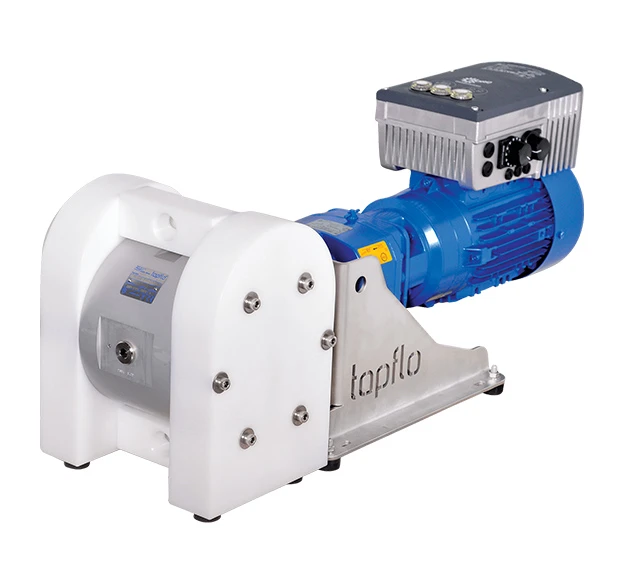
AODD pumps run on compressed air for high pressure/flow and inherent ATEX suitability, while EODD pumps replace air with an electric gear motor to cut running costs at the expense of maximum pressure/flow. The right choice depends on your pressure/flow needs, area classification, and site air availability.
What is an AODD pump?
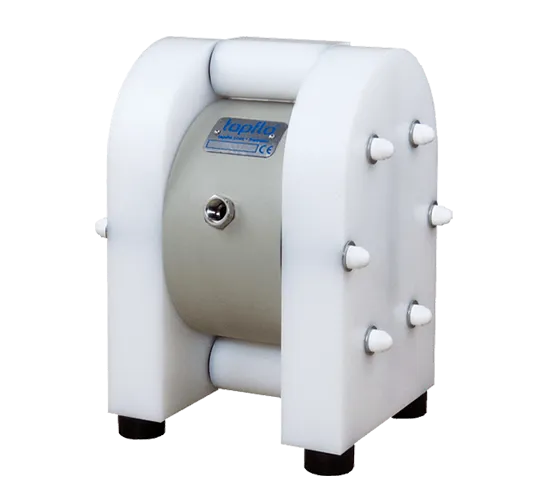
An AODD pump runs on compressed air. Two diaphragms are joined by a shaft and pushed back and forth as an air valve alternately pressurises the chamber behind each one. The pump has no motor, electrical components, or seals, with 70% fewer parts than a standard AODD pump, which is a big part of why they’re straightforward to maintain. The diaphragm separates the pumped fluid from the drive mechanism.
Tapflo’s AODD range includes:
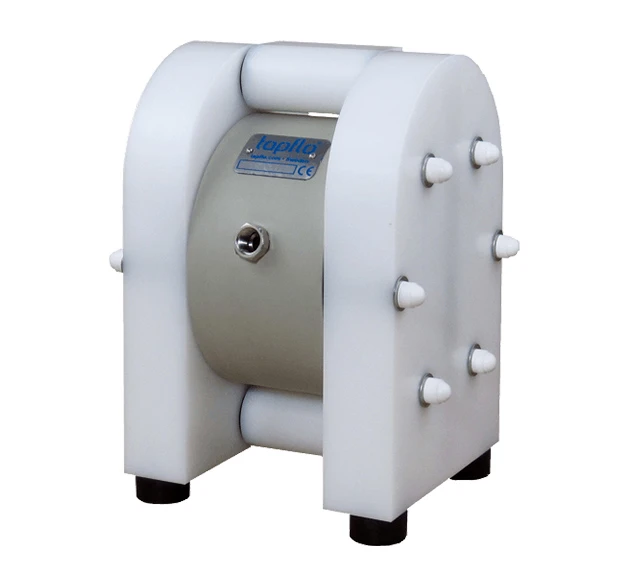
- Solid block HDPE & PTFE Pumps: Machined from solid block, suited to viscous or chemically aggressive fluids and fluids containing abrasive solids
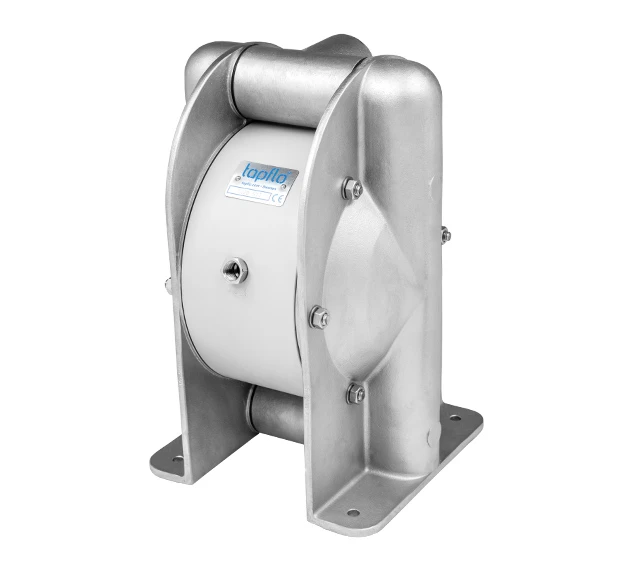
- Metal Pumps: Available in aluminium, cast iron, stainless steel AISI 316, or PTFE-coated aluminium
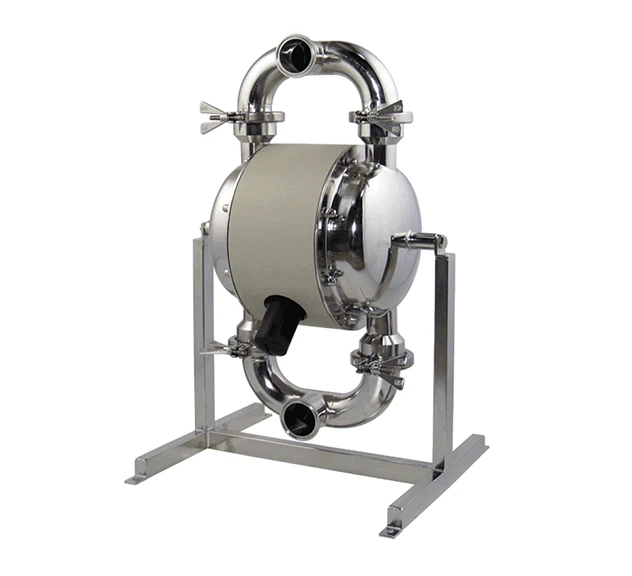
- Sanitary Pumps: FDA-approved, CIP/SIP-capable, with an EHEDG-certified aseptic option for pharmaceutical and biotech use
Key figures:
- Flow up to 820 l/min
- Discharge pressure up to 8 bar
- Connections from 1/4″ up to 4″
- Max size of solids up to 15mm
- ATEX-available across the range for use in hazardous areas
What is an EODD pump?
What is an EODD pump?
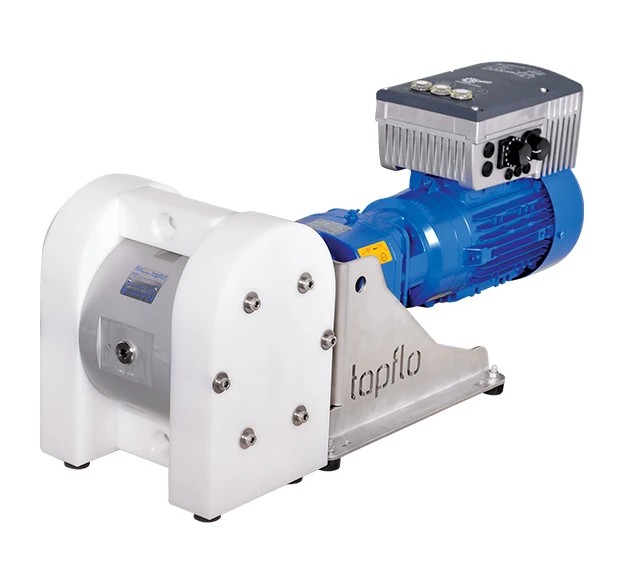
An EODD pump replaces the compressed-air drive with an electric gear motor. The motor drives an eccentric shaft and cam that convert the motor’s rotary motion into reciprocating motion. One diaphragm is drawn back to create suction while the other is pushed forward to discharge, then the cycle reverses.
The diaphragms, valves, and housing are nearly identical to the equivalent AODD pump. That means many spare parts are shared between the two ranges, which keeps spare parts costs down if you run both types.
Key figures (Tapflo range):
- Flow up to 220 l/min
- Discharge pressure up to 4 bar
- IE3-class efficient motor as standard
- Available in plastic (PE & PTFE), metal (aluminium, PTFE-coated aluminium, stainless steel), and sanitary configurations
- ATEX version (TXE series) available for Ex-zone 1 hazardous areas, using conductive materials plus an ATEX-rated coupling and gearmotor
- Optional built-on frequency inverter for full control over motor speed and therefore pump output
AODD vs EODD: The differences
| AODD (Air Operated) | EODD (Electrically Operated) | |
| Drive mechanism | Compressed air via automatic air valve | Electric gear motor via eccentric shaft & cam |
| Max flow (Tapflo range) | Up to 820 l/min | Up to 220 l/min |
| Max discharge pressure (Tapflo range) | Up to 8 Bar | Up to 4 Bar |
| Energy source needed on site | Compressed air supply | Electrical supply |
| Speed/output control | Air pressure/flow regulation | Built-on frequency inverter option |
| Dry-run / dead-head safety | Yes, standard | Yes |
| Sealless design | Yes | Yes |
| ATEX availability | Yes, across the range | Yes, TXE series (Ex-zone 1) |
| Spares in common | Shares design lineage with EODD | Shares wetted-side parts with AODD |
AODD vs EODD: Cost of running
When using compressed air, some energy is lost as heat; the EODD pump’s electric motor eliminates this loss, which is why Tapflo positions EODD as the lower-running-cost option for applications within its flow and pressure range.
For applications that need higher pressure or flow than EODD can deliver, or where compressed air is already installed and readily available, an AODD pump ideally specified with Tapflo’s LEAP (Low Energy Air Pump) technology is worth considering as a lower-running-cost route within the air-driven category. LEAP reduces the pump’s starting air pressure from the industry-standard 1.2 bar to as little as 0.2 bar, directly cutting air consumption, and it can be retrofitted to existing Tapflo diaphragm pumps.
Is an AODD or EODD more suited to ATEX environments?
Both ranges have ATEX-rated options.
AODD pumps are well suited to hazardous areas because, in standard form, they contain no electrical components; the drive is entirely pneumatic.
EODD pumps are available in an ATEX-rated TXE series for Ex-zone 1 environments, built with conductive materials to prevent electrostatic charge build-up, plus an ATEX-rated coupling, gearmotor, and air treatment system.
If avoiding electrical equipment entirely in the hazardous zone is a priority, AODD remains the simpler default; if you want the running-cost benefits of an electric drive in a classified area, the TXE range is the best route.