





Peristaltic pumps use one of two mechanisms to compress the hose: rollers or shoes. The roller design suits lower-pressure applications (up to 4 bar), with less friction and a simpler mechanical setup. The shoe design handles higher pressures (up to 15 bar) and higher flow rates but requires constant lubrication. This guide breaks down how each mechanism works and how to match it to your application.
How Does a Peristaltic Pump Work?
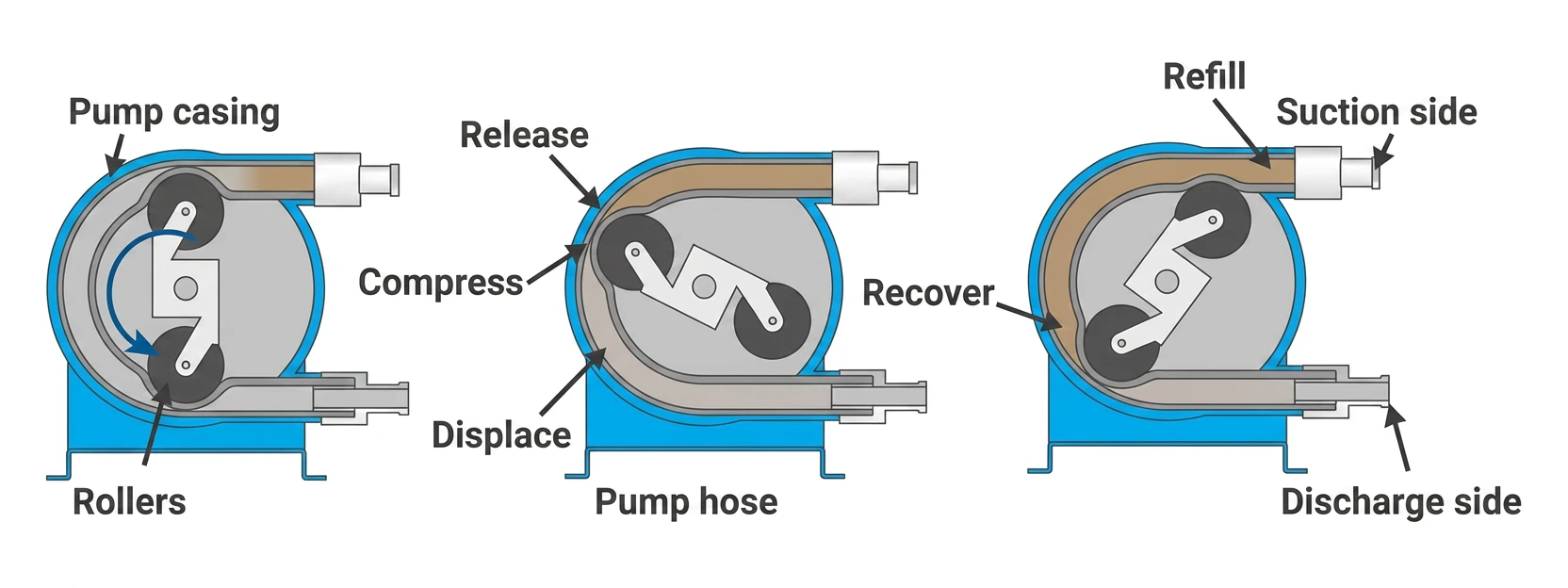
Peristaltic pumps (also called hose, tubing or roller pumps) are positive-displacement pumps that move liquids through a flexible hose. A rotating mechanism compresses the hose, trapping and displacing the liquid towards the discharge. As the compression point moves, the hose recovers its shape, creating suction and drawing in more liquid.
Our article on ‘What is a Peristaltic Pump’ covers the range in more detail.
Working Principle:
Compress → displace → release → recover → refill → repeat
Like peristalsis in the digestive system, travelling compression moves the medium through the hose. Because the liquid contacts only the hose, peristaltic pumps suit abrasive, corrosive, viscous, and solids-laden fluids, as well as applications requiring gentle handling or high hygiene.
The two main designs are roller pumps for lower-pressure applications and shoe pumps for higher-pressure applications. The choice affects pressure capability, friction, heat generation, hose wear, flow and operating cost.
Low Pressure: Roller Design
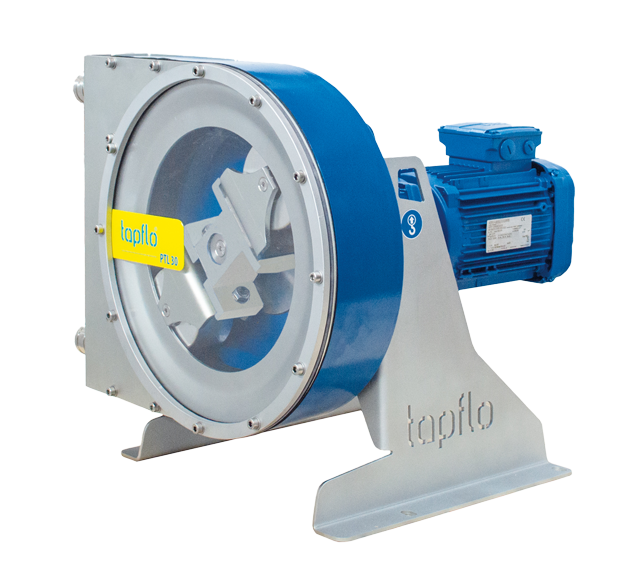
Roller-design pumps use rollers that rotate against the hose. Rolling contact creates less friction than sliding, making it useful when you don’t need high discharge pressure.
The Tapflo PTL range includes seven sizes and suits abrasive, corrosive, and viscous liquids containing solids.
Rollers = lower friction, lower pressure
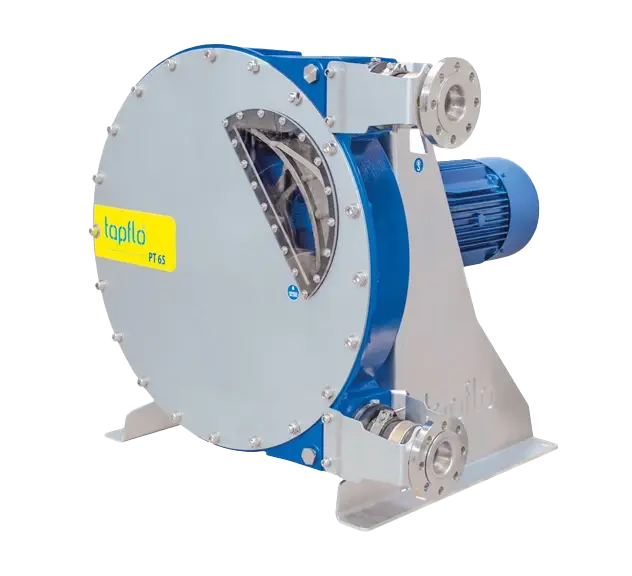
High Pressure: Shoe Design
Shoe-design pumps are designed for higher discharge pressures. Instead of rolling over the hose, the shoes maintain compression against it as they travel around the rotor, keeping the hose closed for more of the cycle.
This allows the pump to handle higher pressure but creates more friction and heat, so continuous glycerine lubrication is needed to cool the pump and keep it running properly.
The Tapflo PT range includes 15 sizes and suits abrasive, corrosive, and viscous liquids.
Shoes = higher friction, higher pressure
High vs Low Pressure: Roller vs Shoe
Both designs compress the hose as the rotor turns, but they differ in the degree of compression.
| Feature | Low Pressure | High Pressure |
| Consideration | Lower friction and lower pressure operation | Higher friction, pressure and heat generation |
| Tapflo Range | PTL | PT |
| Max Discharge Pressure | Up to 4 Bar | Up to 15 Bar |
| Max Capacity | Up to 5 m³/h | Up to 60 m³/h |
| Lubrication | Silicone Grease | Glycerine |
| Typical Industries | Pharma, Food, Cosmetics, Chemical, Water, Treatment | Mining, Wastewater, Paint, Paper, Recycling, Construction, Chemical & Biogas |
Peristaltic Pressure
Maximum pressure and maximum flow cannot always be achieved simultaneously. Flow depends on pump speed, discharge pressure, liquid characteristics and pump size.
Higher pressure requirement → greater mechanical demand → lower achievable flow at a given speed
Lower pressure requirement → less demanding operation → greater flow potential for a given pump and speed
Hose Wear in Peristaltic Pumps
All peristaltic pump hoses wear over time and require replacement. Service life depends on pressure, speed, temperature, pumped liquid and hose material. Tapflo offers NR, NBR, EPDM and CSM hoses, including food-grade and ATEX options.
Viscosity also affects performance because the hose must recover its shape after compression. With very viscous products, slow hose recovery can reduce capacity. A vacuum system can be used on PT pumps to reduce casing pressure and help the hose expand more quickly.
Which Peristaltic Mechanism is Best?
The correct choice depends on the required flow, pressure, viscosity, temperature, fluid characteristics and operating duty. If the process can operate within the lower pressure range, a roller design can provide an efficient solution. Where higher discharge pressure is essential, the additional friction, lubrication and thermal requirements of a shoe design may be justified by its greater pressure capability.
FAQs
Which Peristaltic Pump is Better, Low or High Pressure?
No pumps are universally worse or better, both pumps are equally effective. Low Pressure (roller design) suits gentler handling up to 4 bar, whereas the high pressure model (shoe design) suits higher flow and pressure up to 15 bar.
Read our guide or see individual product pages and data sheets here:
Low Pressure Peristaltic: Low Pressure Peristaltic Pump – Hygienic & Industrial
High Pressure Peristaltic: High Pressure Peristaltic Pump – Hygienic & Industrial
Are Peristaltic Pumps Pulse-Free?
Peristaltic Pumps exhibit low pulsation, but the bigger the peristaltic size, the higher the pulsation. Tapflo offers a pulsation dampener to provide pulse-free flow if your application requires it.
Can Peristaltic Pumps run continuously?
Yes, Peristaltic Pumps can be run continuously. They can operate at multiple duty points, whether continuous, intermittent, or occasional.
How long will my Peristaltic hose will last?
We’ve developed our own hose life expectancy calculator. By factoring in your operating parameters, it estimates your hose lifespan, so you can stay ahead of your PPM schedule instead of reacting after the fact.
Learn about our available hoses on the product page or in our guide.
Curious what yours would be? Get in touch today, and we’ll provide a no-obligation hose life estimate tailored to your application.
Why should you choose a Tapflo Peristaltic Pump?
Tapflo’s Peristaltic Pumps are one of the most popular products in the Tapflo portfolio. This is because they are highly versatile for both aggressive media and chemicals, as well as for sanitary food and beverage applications. Their robust construction and hoses that are stronger than 30% of all hoses on the market make them the ideal pump for your needs.
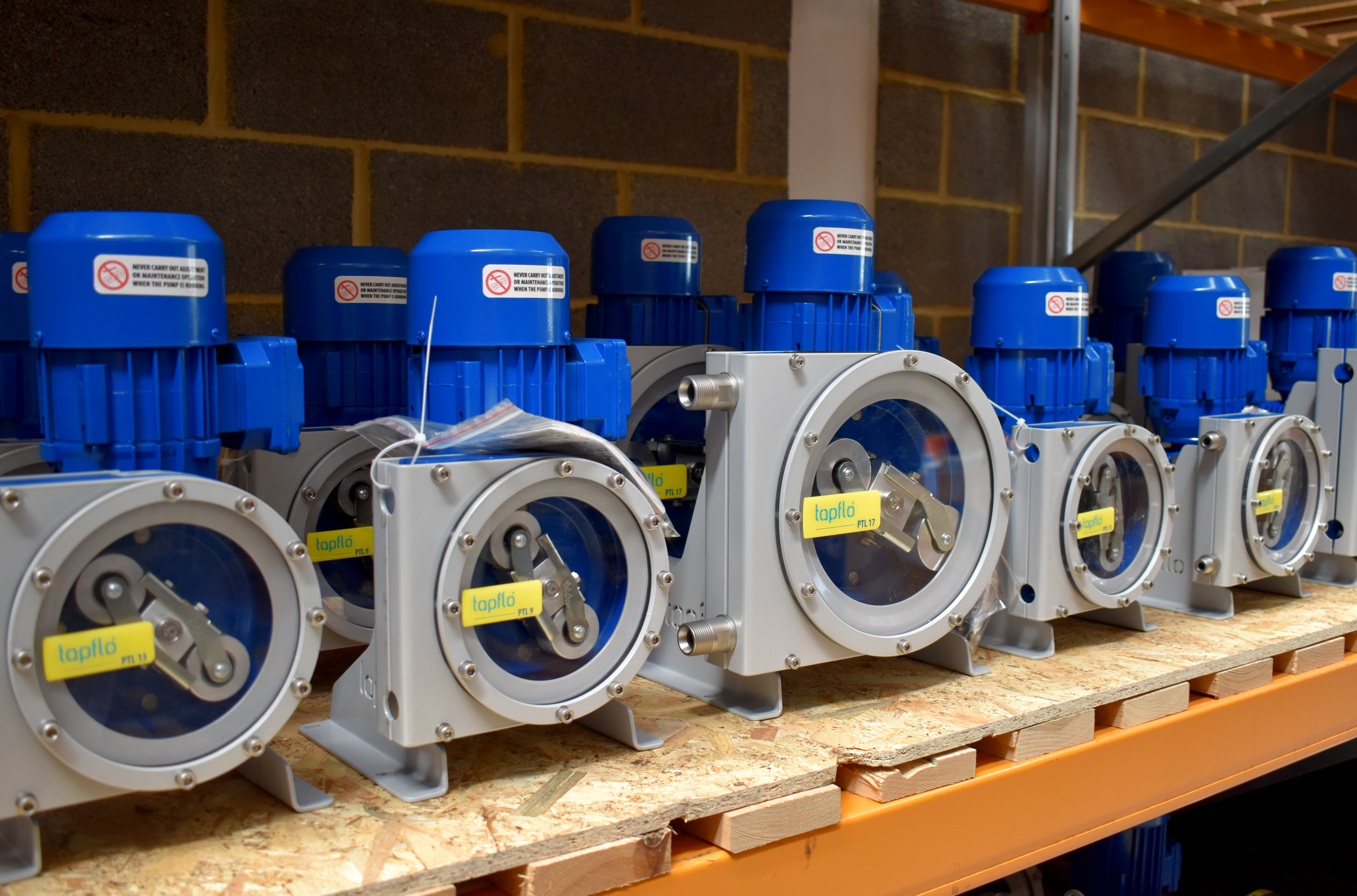
Our PT and PTL ranges are available from stock in the UK! Get in touch for a quick turnaround on your next project.