BY TYPE
BY APPLICATION
BY BRAND






Official UK partner of Liverani
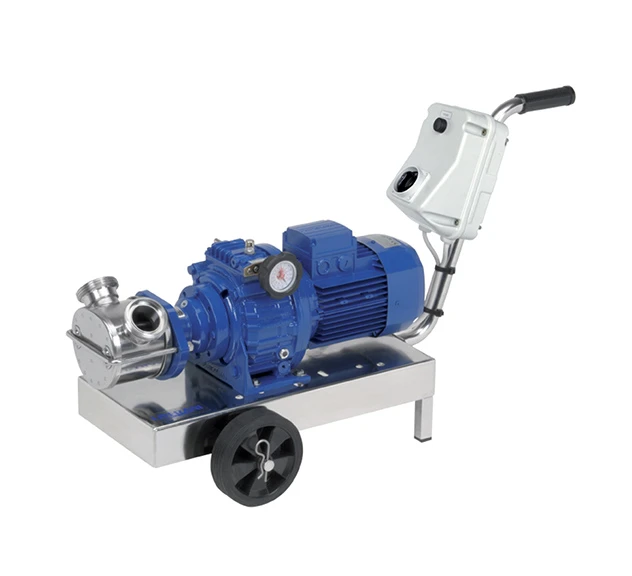
The RID Gearbox Drive Flexible Impeller Pump, is characterised by its close-coupled design to a geared motor. This pump excels at handling medium- to high-viscosity, shear-sensitive, and abrasive fluids with viscosities up to 50,000 cPs.
This model can be supplied trolley-mounted, with or without baseplates, with or without control panels and with wired dry-run protection. Additionally, FDA-approved EPDM and NBR impellers are available for enhanced sanitation.
Typical applications include:
| Max Flow (l/min) | 730 l/min |
| Max Pressure (m) | 32m |
| Max Solids Passage (mm) | 25mm |
| Voltages | 12 & 24V DC 110, 230 & 400V (MF & TF) |
| No. of Speed Settings | 1 or 2 |
| Max Speed (rpm) | 1400 |
All models are 3-phase with Manual or spring-loaded by-passes available on request.
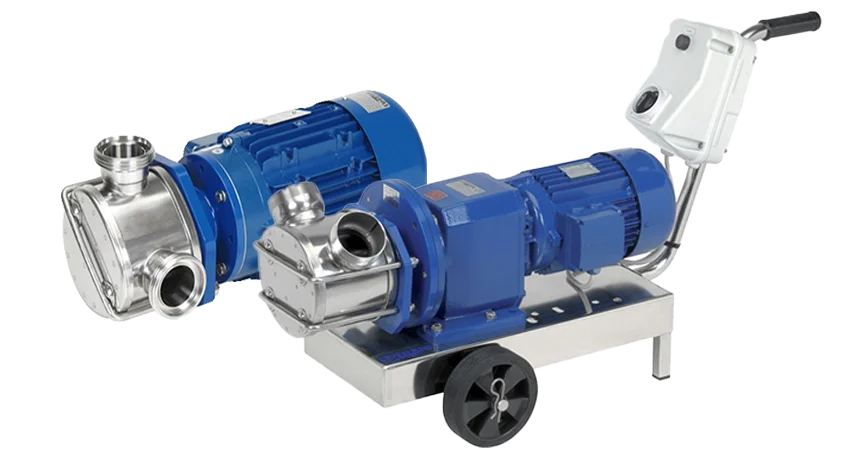
This self-priming positive displacement pump transfers fluid by trapping it between flexible impellers and moving it from the suction to the discharge port. Mounted on a trolley with an integrated on/off switch, it offers convenient operation and portability.
The range includes models optimised for higher flow (RID MAXI DOUBLE 2Q) or higher head (RID MAXI DOUBLE 2H). Units can be supplied with baseplates, control panels, dry-run protection, and manual or spring-loaded bypasses. Available in 3-phase, with speeds from 235–700 rpm and a range of connection options.
A custom system using Flexible Impellers for creating faux leather with green waste.
What a Flexible Impeller Pump is, how it works, and how it can be used for your sector.
A mobile pump solution to fill and empty tanks for non-alcoholic botanical drinks.
The Gearbox Drive Flexible Impeller Pump works by rotating a flexible impeller inside the casing. The impeller bends as it turns, trapping liquid and moving it smoothly from the suction side to the discharge side, allowing pulsation-free, reversible flow.
A Centrifugal Pump is a Rotodynamic pump that passes energy from the motor to the liquid, which forces the fluid out of the discharge port. Whereas the Impeller Pump is a Positive Displacement Pump that traps small amounts of liquid and forces it from the suction to the discharge port.
This series is close-coupled to a geared motor, making it ideal for medium to high-viscosity and shear-sensitive fluids. It also allows rotation of the pump head into different porting positions and offers higher performance with RID MAXI DOUBLE models, which can double the flow or head.
Typical applications include oenological processes, breweries, food and food oils, chemical and cosmetic fluids, pharmaceutical transfer and wastewater treatment.
Yes, they can self-prime up to 6m suction lift from dry.
No. Running dry can damage the impeller and mechanical seal. However, wired dry-run protection is available as an option to safeguard against this.