BY TYPE
BY APPLICATION
BY BRAND






Official UK partner of Liverani
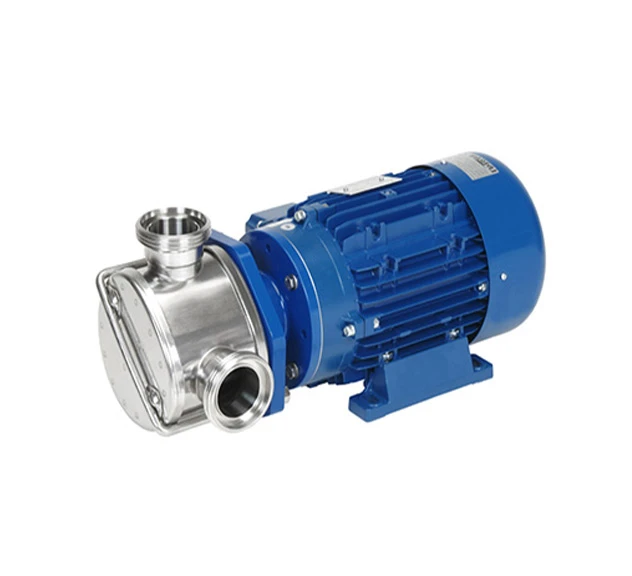
Our EP Flexible Impeller Pump (also known as a Flexible Vane Pump) is self-priming and the most commonly used in our range.
An on/off/reversing switch can be located on the motor’s terminal box for enhanced versatility. Additionally, this pump can be fitted with carrying handles (U and L-shaped) or trolleys (Zinc-coated Iron & Stainless-Steel 304), making it a highly versatile and efficient utility pump.
Typical applications:
| Max Flow (l/min) | 730 l/min |
| Max Pressure (m) | 32m |
| Max Solids Passage (mm) | 25mm |
| Voltages | 12 & 24V DC 110, 230 & 400V (MF & TF) |
| Max Speed (rpm) | 1400 |
| Pump Heads | AISI 304 AISI 316 |
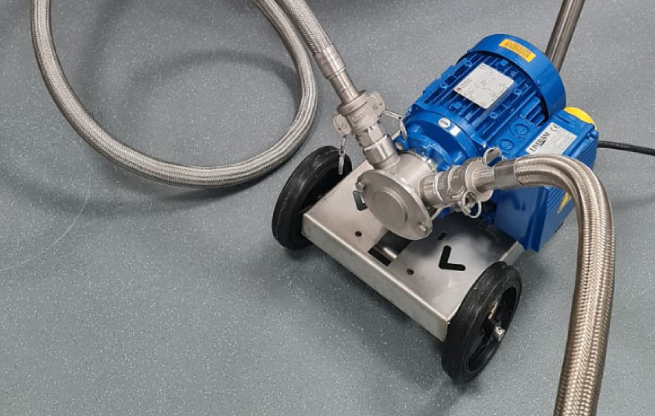
EP Self-Priming Flexible Impeller Pumps feature a close-coupled design with an integrated on/off/reverse motor switch and are available in single and three-phase configurations.
Ideal for transfer, filling, and emptying duties across a wide range of industries, they can be supplied with carrying handles or trolley-mounted options for enhanced portability.
Available with manual or spring-loaded bypasses, voltage options from 12V DC to 400V AC, and speeds from 470–1400 rpm. EP MINI and MIDEX models are supplied with stainless steel hose connections as standard, with alternative connection options available on request.
They can be customised in many ways, including:
A custom system using Flexible Impellers for creating faux leather with green waste.
What a Flexible Impeller Pump is, how it works, and how it can be used for your sector.
A mobile pump solution to fill and empty tanks for non-alcoholic botanical drinks.
This pump operates by the rotation of the internal shaft, which causes the flexible impeller to bend against the casing, pushing fluids and solids out of the discharge port.
A Centrifugal Pump is a Rotodynamic pump that passes energy from the motor to the liquid, which forces the fluid out of the discharge port. Whereas the Impeller Pump is a Positive Displacement Pump that traps small amounts of liquid and forces it from the suction to the discharge port.
Suitability depends on the application and material selection. The EP range offers impellers in Natural Rubber, Neoprene, NBR, EPDM and Silicone, plus various mechanical seal options. While this allows handling of many different fluids, it is not primarily intended for highly abrasive media or aggressive chemicals without carefully matching your materials to suit them.
Yes, they can self-prime up to 6m suction lift from dry.
No, it can’t dry run as it may cause damage to the motor. Dry Run Protection Devices and Float Switches are available on request to support dry running of this pump.