




Tapflo UK were asked to supply a Peristaltic Pump within a quick lead time to a client looking to transfer digestate within their Anaerobic Digestion Plant.
This case study shows how Tapflo UK replaced an anaerobic digestion plant’s unreliable progressing cavity pump with a heavy-duty peristaltic pump, eliminating clogging, reducing maintenance costs, and delivering reliable digestate transfer with improved efficiency and easier servicing.
Anaerobic Digestion Plant Pump Solution
- Customer: A Tapflo Distributor
- End-User: An Anaerobic Digestion Plant
- Location: UK
Enquiry Details and Requirements
Tapflo UK only works with the most trusted and reliable equipment and partners. When we were contacted by one of our UK distributors to supply a trustworthy, well-made Peristaltic Pump within a quick lead time, we jumped at the chance to come to their aid.
The distributor’s client who managed an Anaerobic Digestion Plant, had contacted them to assess the problems they were having with their current progressing cavity pumps. The pump was proving problematic for the customer in a couple of ways:
- The pump was consistently clogging and running dry upon start-up.
- The pump failed to deliver the required capacity (30 m³/hr) when the plant was operating at its heaviest solids load of 25-30%.
- The client didn’t have suitable lifting equipment for the existing pump.
Every time they needed to conduct any routine inspections or maintenance, they had to hire a crane to lift the pump in and out of the tank it was installed in, and wait while the work was carried out. This resulted in costly and unnecessary maintenance costs which could be avoided.
Equipment Supplied to the Anaerobic Digestion Plant
For this process, we knew exactly which pump solution to supply, due to the fluid characteristics and demands of the application.
We supplied the client with:
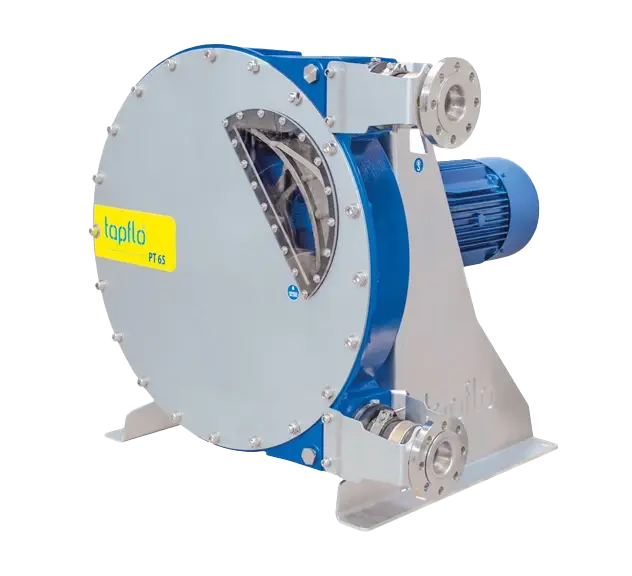
PT-100 – Heavy Duty Peristaltic Pump
Specifications of the pump:
- Fluid: Organic Waste Sludge w/ Abrasive Solids in Suspension (25-30%)
- Capacity: 30 m³/hr
- Max Discharge Pressure: 5 Bar
- Required Suction Lift: 4-5 m
- Capable Suction Lift: 9 m
- Inlet / Outlet Connections: DN100 / PN16
- Stainless Steel Flanges Geared Motor: 15 kW / 1500 rpm / 3 Phase / 50 Hz / IP55 / Class F
- Output Speed: 36 rpm
- Body, Wheel, Pressing Shoes: Ductile Cast Iron GGG40
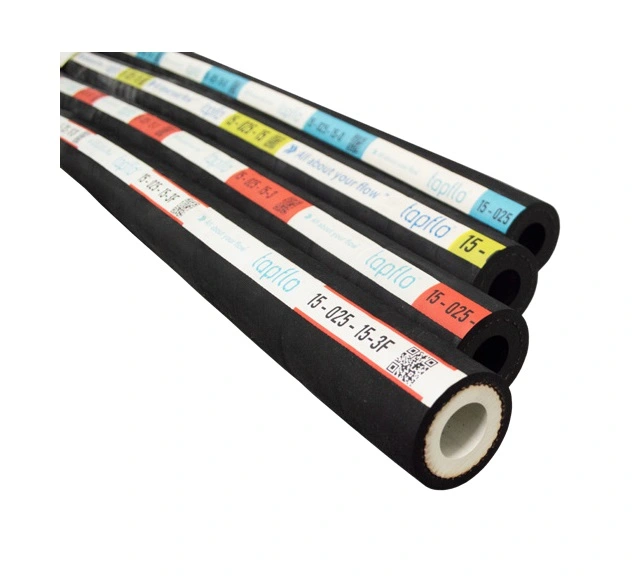
- Hose: High-Pressure Natural Rubber (20 Bar Max), Multi-Layered & Reinforced w/ Braided Polyamide (21.25 mm Thickness / 4 m Length)
- Frame: Painted Steel
- Flanges & Inserts: Stainless Steel
- Bolts & Nuts: Stainless Steel AISI 304
- Paint: Anti-Corrosion Coating, Blue, Primary and Final Polyurethane. Acry-Epoxy, 150 microns thickness.
Fitted Accessories
Accessory specification:
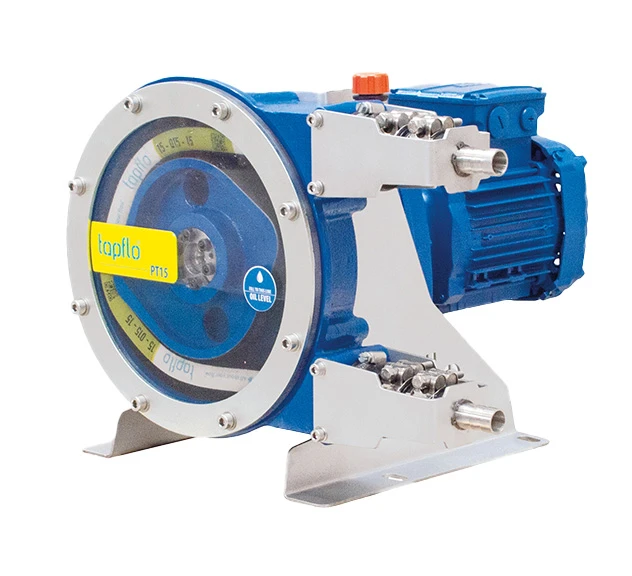
- PT-100-VAC Air Operated Vacuum System – enables increase suction lift capability on high viscosity and solids laden fluids Hose Rupture Detector (Suco Pressure Sensor)
Solution & Support Offered
Further to our distributor’s site visit and report on the existing installation, the end-user was recommended to replace the existing pump with a Peristaltic Pump. These types of pumps have several unique features which were perfect in resolving the end-users’ issues with their existing unit.
Peristaltic Pumps are seal-less and leak-free. Any rupture of the hose within a Peristaltic Pump is contained within the pump casing, therefore, avoiding messy leakages onto the installation. The pump can also be fitted with a hose rupture sensor and alarm to stop the pump in case of a rupture and signal the plant manager that there has been a failure and call for a hose replacement.
Benefits of the Peristaltic Pump:
- Designed to handle both low and high viscosity with solids whilst maintaining pressure and delivering constant flow – Therefore, they are perfectly suited for digestate transfer and can adapt to changes in the process.
- Capable of running dry indefinitely – This cuts out downtime and costs associated with this issue. However, even though these types of pumps can run dry, it is not recommended for continuous dry-running. However, we offer a variety of dry run protection devices that help eliminate this and therefore save on unnecessary operating costs.
- Generate near-perfect vacuum and provide suction lifts of up to 9.8 m vertically – This means that the pump can be kept outside of the tank, meaning easier and quicker inspection and maintenance and avoiding unnecessary crane hire costs!
- The only wear part in a Peristaltic Pump is the hose – It can be easily switched out and is long-lasting, meaning cost-effectivity and easy maintenance.
- Bi-directional (can be operated equally in both directions) – The pump can be run in reverse on start-up to dislodge any blockages and settlement within the pipework during periods of downtime
How Tapflo successfully served an Anaerobic Digestion Plant
Tapflo UK offered further assistance and support in conjunction with their distributor during the initial commissioning and installation of the Anaerobic Digestion Pump, to ensure that the equipment was being utilised to its full potential.
We can offer site visits, troubleshooting and system appraisal to ensure that our customers and partners are getting the best out of their pumps and systems.
If you’re looking for a little more information on Tapflo’s Peristaltic Pump, read our Peristaltic Pump Guide or if you need any help selecting which one, read our Peristaltic Pump Blog: Selecting The Right Peristaltic Pump.